

Maybe you don’t know who invented these everyday bojects
There are objects we use every day with the same naturalness as breathing. We touch them, turn them on, connect them, update them. They’ve become so familiar that they seem inevitable, as if they had always existed. And yet, behind each of these tools there is a person, a story, a sudden intuition or an obsession cultivated for years in a garage, in a university lab, or in a small room filled with cables.
Technology is not just the result of big companies and famous brands: it is made of faces, failed attempts, sleepless nights, and ideas that at first seemed strange, if not completely useless. In this journey, you’ll discover who invented some of the most common technological objects and, perhaps, you’ll look at your smartphone or your keyboard a little differently.
The Mouse
Today we consider it a basic accessory, but when Douglas Engelbart introduced the first mouse in 1968, it looked like something straight out of a woodworking shop. It was literally a small wooden block with two metal wheels and a button. Engelbart didn’t just want to invent a device; he wanted to augment human intelligence through interaction with computers.
His public demonstration, later known as “The Mother of All Demos,” showed for the first time a cursor on the screen, windows, and even the concept of video conferencing. All of this at a time when computers filled entire rooms. The mouse, initially underestimated, would go on to become the symbol of personal computing.
The QWERTY Keyboard
Every day we type on QWERTY keyboards without wondering why the letters are arranged in that apparently chaotic way. The inventor of this layout was Christopher Latham Sholes in the 19th century, long before computers even existed.
The keyboard was created for typewriters. The mechanical arms tended to jam if nearby letters were typed too quickly. Sholes studied a layout that would slightly slow down typing, reducing jams. Paradoxically, a solution designed to limit speed became the global standard even in the digital age.
The World Wide Web
Many people confuse the Internet with the Web, but the World Wide Web is just one of the services that runs on the Internet. It was invented by Tim Berners-Lee in 1989 while working at CERN in Geneva.
Berners-Lee wanted to create a system for easily sharing scientific documents among researchers. He invented HTML, the HTTP protocol, and the first browser. The most extraordinary part? He chose not to patent his invention. The Web remained free and open, allowing anyone to build websites, services, and entire digital empires.
The Microprocessor
Every smartphone, computer, or smartwatch contains a microprocessor. Few people know that the first commercial microprocessor, the Intel 4004, was developed in 1971 by a team led by Federico Faggin, an Italian engineer, along with Ted Hoff and Stanley Mazor.
The revolutionary idea was to concentrate computing functions that previously required entire circuit boards into a single chip. That invention paved the way for the miniaturization of electronics and made personal computing possible. Without the microprocessor, you probably wouldn’t be reading this article on a screen.
The Touchscreen
We scroll, tap, and zoom with two fingers. The gesture is intuitive, almost instinctive. Yet the first touchscreen dates back to the 1960s. It was Eric Arthur Johnson, a British engineer, who developed one of the first capacitive versions in 1965.
At the time it was used for air traffic control. No one imagined that decades later it would become the heart of smartphones. Direct interaction with the screen transformed the way we experience technology, making it more immediate and personal.
Wi-Fi
It may sound unbelievable, but part of the technology behind Wi-Fi owes a lot to Hedy Lamarr, a Hollywood actress from the 1940s. Together with composer George Antheil, she developed a “frequency hopping” communication system to guide torpedoes without being intercepted.
The invention was patented in 1942 but ignored for years. Only decades later would the principle of frequency hopping be used in wireless communications, paving the way for Wi-Fi and Bluetooth. Behind your home’s wireless connection there is also the brilliant mind of a movie star.
The USB Flash Drive
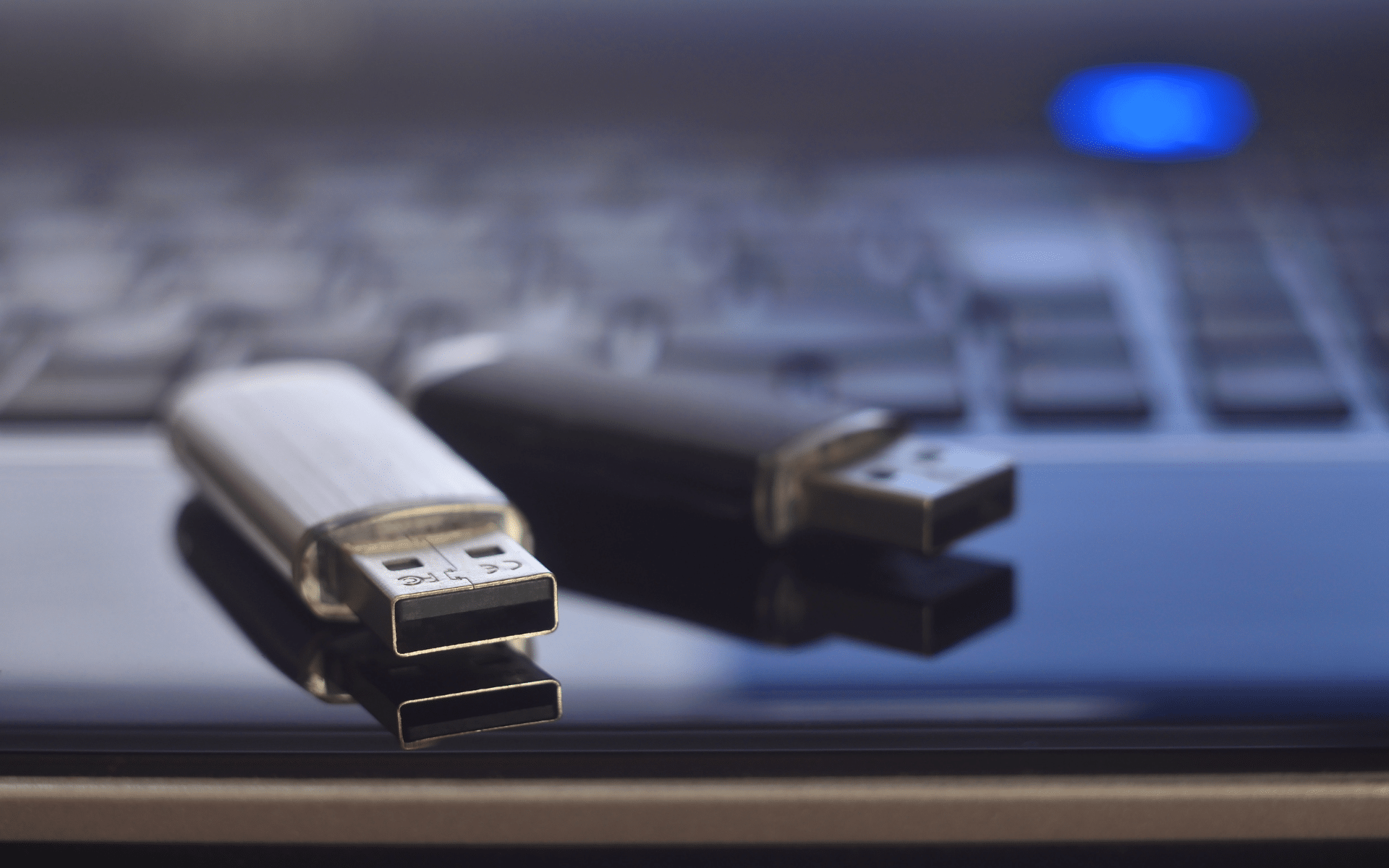
Before the USB flash drive, transferring data was a nightmare of floppy disks and burned CDs. The device we know today is linked to the name Dov Moran, an Israeli entrepreneur who, in the late 1990s, developed a portable memory device based on flash technology.
The idea was simple but brilliant: a small, durable device with no moving parts, capable of working on any computer with a USB port. That simplicity changed the way we carry information, anticipating the very concept of digital portability.
The Webcam
The first webcam in history was not invented for romantic video calls or Zoom meetings. In 1991, researchers at the University of Cambridge, including Quentin Stafford-Fraser and Paul Jardetzky, connected a camera to an internal network to monitor a coffee pot.
The problem was simple: walking back and forth only to find the pot empty. The solution was to transmit images in real time. Without realizing it, they had created the prototype of a tool that today is essential for remote work and global communication.
The QR Code
We scan it to read a menu, pay a bill, or download an app. The QR code was invented in 1994 by Masahiro Hara, an engineer at Denso Wave, a Japanese company linked to Toyota.
It was designed to track automotive components more efficiently than traditional barcodes. Its square structure allowed it to store much more information. For years it remained confined to industry, until smartphones with cameras turned it into an everyday tool.
The Android Operating System
Today Android is the most widely used operating system in the world on smartphones, but few remember that it was founded by Andy Rubin in 2003 as an independent startup.
The original idea was not even to create a system for phones, but a platform for smart digital cameras. When Google acquired the company in 2005, the project changed direction. Since then, Android has become the heart of billions of devices, redefining the mobile market.
Cloud Computing
When you save a file on an online service, you’re using the cloud. But the concept of shared computing dates back to the 1960s. It was J.C.R. Licklider, a psychologist and computer scientist, who imagined a “galactic network” of interconnected computers.
His vision was of a system in which people could access data and programs from anywhere. At the time it seemed like science fiction. Today it is the foundation on which companies, streaming platforms, and personal digital archives are built.